
Cover Junior ADU Conversion: The Upland Owner’s Guide
Cover junior ADU conversion in Upland typically runs $85,000-$140,000 all-in, from the initial site assessment through final inspection, with the permit set and construction under a single written contract. We stock Cover-compatible components and coordinate directly with Cover’s supply chain for model-specific structural connectors, window systems, and utility integration kits. Most Upland owners discover something’s off when the unit’s utility chase doesn’t align with their existing main-house lateral, or when the foundation prep specified by Cover’s site manual doesn’t match the sloped grade common to north Upland lots near the San Antonio Heights ridgeline.
We’ve handled enough of these to know the failure pattern: the part that “fails” is rarely the Cover module itself. It’s the conversion layer, the site-specific adaptation that bridges Cover’s standardized system to your particular foundation, utility stub, and San Bernardino County fire-setback requirement. That’s where we focus our stock and our planning.
Which Cover Models This Applies To
Cover currently produces the Backyard Studio line in 400 sq. ft. and 500 sq. ft. configurations, both of which qualify as junior ADUs under California’s JADU provisions when attached to or converted within an existing residential structure. The critical identifier is the serial plate on the electrical panel enclosure, which lists the model series (BY-400 or BY-500) and the production batch. Batches manufactured before Q3 2022 used a 2-inch utility chase penetration; post-Q3 2022 units switched to 3-inch to accommodate PG&E’s updated lateral sizing for all-electric service in San Bernardino County.
We stock both chase adapters. The OEM part from Cover runs higher and carries their 10-year structural warranty; our aftermarket equivalent, fabricated by a Long Beach specialty metal shop we’ve used since 2019, matches the spec at roughly 60 percent of OEM cost and carries our 365-Day Done Right Promise instead. For Upland’s inland heat cycling, we’ve found no performance difference. The only compatibility gotcha: Cover’s 2021-2022 transition units shipped with a proprietary foundation anchor pattern that doesn’t match the current universal bracket. We keep both anchor sets on the truck.
Signs Your Cover Junior ADU Conversion Is Failing
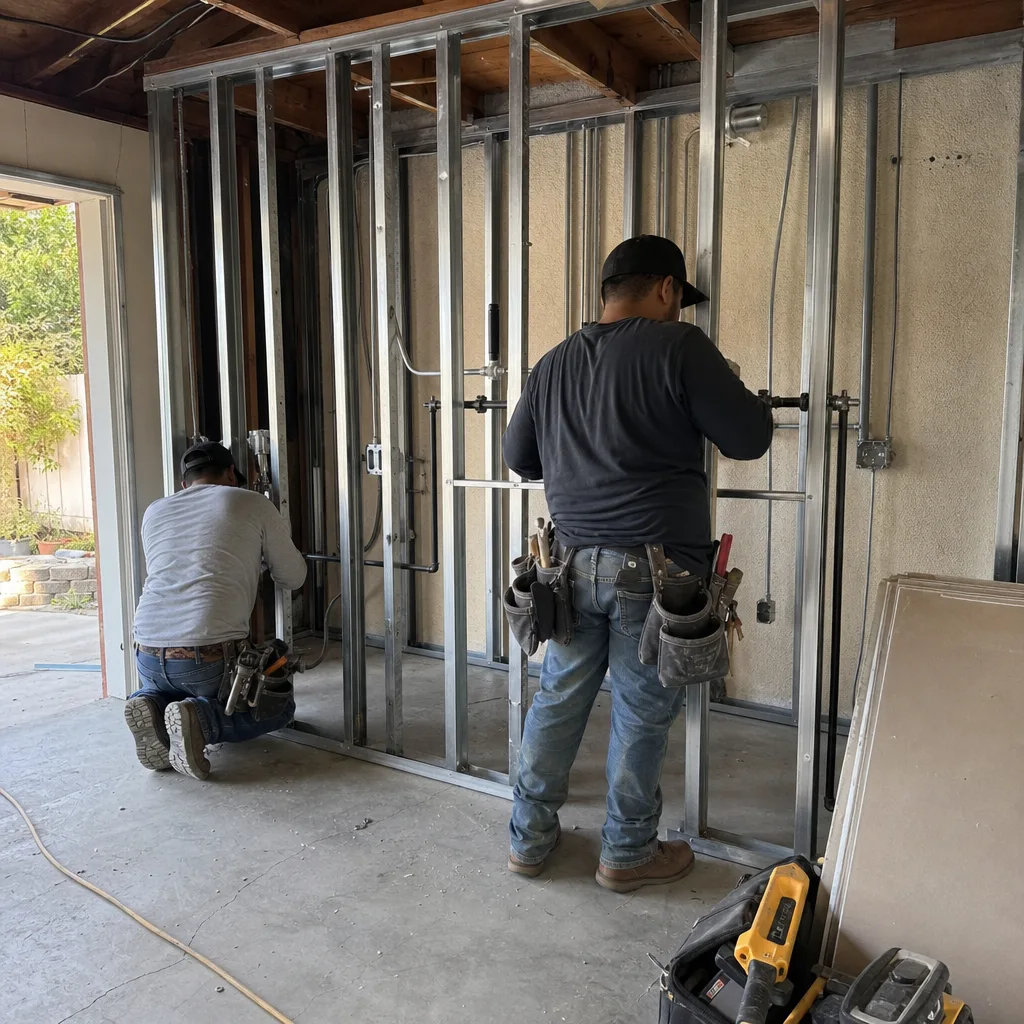
- Utility chase misalignment. Your electrician can’t pull the feeder cable without bending radius violations. This usually means the conversion adapter was shimmed rather than re-fabricated when the slab proved 2 inches out of level, a shortcut we see on north Upland hillside lots where the original survey used assumed, not verified, elevations.
- Window weep channels draining inward. Cover’s units ship with flush-mounted windows designed for flat-grade installation. On sloped Upland sites, the conversion framing must include a sloped sill pan. When it’s omitted, water tracks behind the Hardie panel and pools in the subfloor. We’ve replaced three subfloors on Lemon Avenue corridor jobs where this detail was missed.
- Foundation anchor bolts working loose after the first winter. San Bernardino County’s clay-heavy soils expand and contract through Upland’s 40-degree seasonal swing. The standard Cover anchor kit specifies torque values for stable soils; our conversion includes helical tie-downs for the local soil profile, installed at no additional line item under Haven Standard Clause 3 (Site-Appropriate Methods).
- HVAC short-cycling. The mini-split specified in Cover’s standard package is sized for the module’s envelope load only. Junior ADU conversions in Upland often inherit poor insulation from the existing structure’s original 1960s-1980s construction. We calculate the combined load and spec the correct Mitsubishi or Daikin unit during the permit set phase, not as a change order.
- Permit corrections piling up. San Bernardino County’s ADU plan check currently runs 6-8 weeks. Every correction adds another 3-4 weeks. The most common correction we see on Cover conversions: fire-rated separation assemblies between the JADU and main residence that don’t match the detail in the approved Cover engineering letter. We obtain that letter upfront and build it into the permit set before submission.
Replacement Cost & What’s Included
Cover junior ADU conversion in Upland, scoped as a full re-work of an existing failed installation, typically runs $45,000-$85,000 depending on how much of the original conversion layer must be removed. Here’s how the range breaks:
- Foundation re-prep and helical tie-downs: $8,000-$14,000
- Utility chase re-fabrication and electrical lateral: $6,500-$11,000
- Window/sill pan corrections and weatherization: $4,000-$7,500
- HVAC resizing and duct modification: $5,500-$9,000
- Permit set revision and re-submission: $3,500-$5,500 (included in our single contract, never a separate invoice)
- Structural separation and fire-rated assembly: $7,500-$15,000
- Finish repair and documented photo record: $4,500-$8,000
Every project is quoted with a written price before any work begins, per Haven Standard Clause 1. The scope is locked at signing; no door-side upsells, no scope creep. Under Clause 5 (No Surprises), if we find concealed damage during demolition, we document it with photos, pause work, and present a signed change order with a new written price before proceeding. Our 365-Day Done Right Promise covers the full conversion, not just the Cover module.
DIY or Call Us?
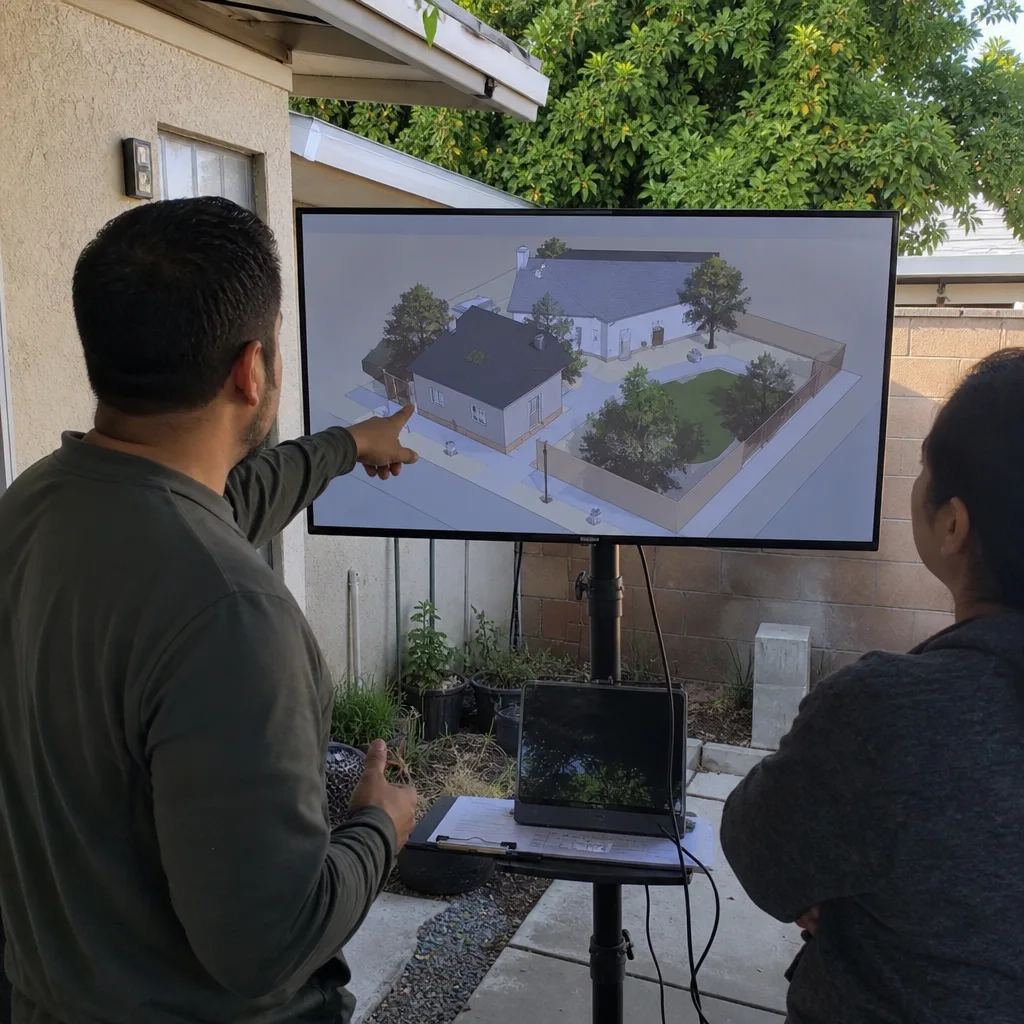
There’s a safe middle ground and a hard stop. An owner can verify the model serial, photograph the utility chase and foundation anchors, and check the window sill pans for proper slope and sealant. That’s useful information and it doesn’t put anyone at risk.
The hard stop is anything involving the structural connection between the Cover module and the existing residence, the electrical lateral pull, or the fire-rated separation assembly. These are permit-triggered, inspection-required, and genuinely hazardous if guessed wrong. A failed structural connection in a seismic zone is a life-safety issue, not a maintenance item. We’ve been called in after two owner-attempted conversions in Upland and Rancho Cucamonga where the permit was never pulled and the fire separation was built with standard drywall. Both required full demolition and restart.
If you’re unsure where your project stands, call (840) 212-3065. We’ll do a free site review and tell you exactly what’s code-compliant and what isn’t, with a written estimate if work is needed.
FAQs
Properly converted and maintained, 30-40 years for the structural assembly, 15-20 for the mechanical systems before major component replacement. The limiting factor in Upland is usually the HVAC compressor, which works harder through 100-degree summer weeks and may cycle 30 percent more annually than in coastal zones. We spec Mitsubishi units with extended warranties for this reason. Call (840) 212-3065 for an exact quote on your model and site - estimates are free.
Partial repair is possible when the failure is isolated to one subsystem - a misaligned chase, a single failed anchor, a window detail. When multiple systems are compromised or the original work was unpermitted, full replacement is usually more cost-effective than chasing interconnected defects. We assess this on every site visit and document our recommendation with photos. Call (840) 212-3065 for a free second opinion on any written estimate you already have in hand.
Construction typically runs 8-12 weeks once permits are in hand. San Bernardino County’s ADU plan check is currently 6-8 weeks for a complete new submittal, 3-4 weeks for a revision to an existing approved set. We coordinate directly with Cover’s logistics team for module delivery scheduling, which is usually the pacing item. Our permit set includes every document the county requires, submitted once, to avoid the correction cycle that adds months to most projects.
We stock the common failure items: both chase adapter sizes, both foundation anchor patterns, fire-rated assembly materials, and the proprietary fasteners Cover specifies for their panel-to-frame connections. Module-specific components - windows, doors, the structural shell itself - ship from Cover’s factory and typically arrive in 4-6 weeks. We coordinate that delivery as part of our single-contract scope, so the timeline is our responsibility, not yours. Call (840) 212-3065 to confirm current availability for your model and batch.
Ellery ADU Studio Upland is an independent design-build studio, not affiliated with Cover. We specify and coordinate Cover systems alongside Abodu, Dvele, and other prefab brands under the same single-contract, written-price model we’ve used since 2015.
Read the clause, then read the cost range - if either one surprises you, we haven’t done our job yet.
Ready to fix what’s failing? Call (840) 212-3065 to schedule your free estimate. Nadia Ellery or a member of our crew will walk the site, photograph what we find, and return a written scope with a single price before any work begins.
Written by Nadia Ellery, Principal, Ellery ADU Studio Upland at Ellery ADU Studio Upland, serving Upland and nearby areas.