
Abodu Junior ADU Conversion: The Upland Owner’s Guide
Abodu junior ADU conversion in Upland typically runs $85,000-$140,000 all-in, from the initial site survey through final San Bernardino County inspection, with most units permitted and built within 8-14 months. We stock and coordinate Abodu-compatible systems for junior ADU conversions - interior reconfigurations of existing square footage within a primary residence - and we carry the critical connection hardware, utility integration kits, and finish-out components that bridge Abodu’s prefab shell with your existing structure. If your Abodu junior ADU conversion is showing signs of failure, it’s usually at the utility handoff points: the wet wall connection where Abodu’s compact plumbing meets your older Upland home’s supply, or the mini-split line set penetration where Inland Empire summer heat cycles have degraded the seal.
Most Upland owners discover the problem when the unit’s electrical subpanel throws intermittent breakers, the wet wall shows moisture at the baseboard, or the HVAC can’t hold temperature against a 105-degree August afternoon. These aren’t cosmetic issues. They’re integration failures between a precision-manufactured module and a 1950s-1980s Upland tract home that wasn’t built for it.
Which Abodu Models This Applies To
The junior ADU conversion applies to Abodu’s interior-focused line - primarily the Abodu One configured for attached or interior deployment, and certain Abodu Studio variants specified for garage-to-living or primary-residence partition conversions. These are not the freestanding detached units you see in backyards; they’re the 350-550 square foot modules designed to slot into existing envelope space.
To identify your exact system, check the Abodu serial plate - usually mounted on the electrical subpanel door or the wet wall access panel. You’re looking for a prefix: ABD-JR indicates junior conversion specification, while ABD-DT means detached and this page isn’t your resource. The model year matters because Abodu revised their wet wall connector standard in 2021; pre-2021 units use a 2-inch sanitary stub that often conflicts with Upland’s older 1.5-inch cast iron mains, while 2021+ units ship with an adaptive hub that we specify differently in the permit set.
On OEM versus aftermarket: Abodu warranties their shell and structural components for 10 years, but the integration hardware - the coupling kits, line-set penetrations, and electrical subpanel adapters - are where independent specification saves money without sacrificing performance. We source these through certified Abodu-compatible suppliers, not Abodu direct, and we document every part number in your permit set so the inspector can verify compliance. For Upland’s specific soil conditions and seismic requirements, we often specify upgraded anchor brackets at the foundation tie-in; the standard Abodu kit meets code, but the upgraded hardware accounts for the Inland Empire’s liquefaction zones without adding significant cost.
Signs Your Abodu Junior ADU Conversion Is Failing
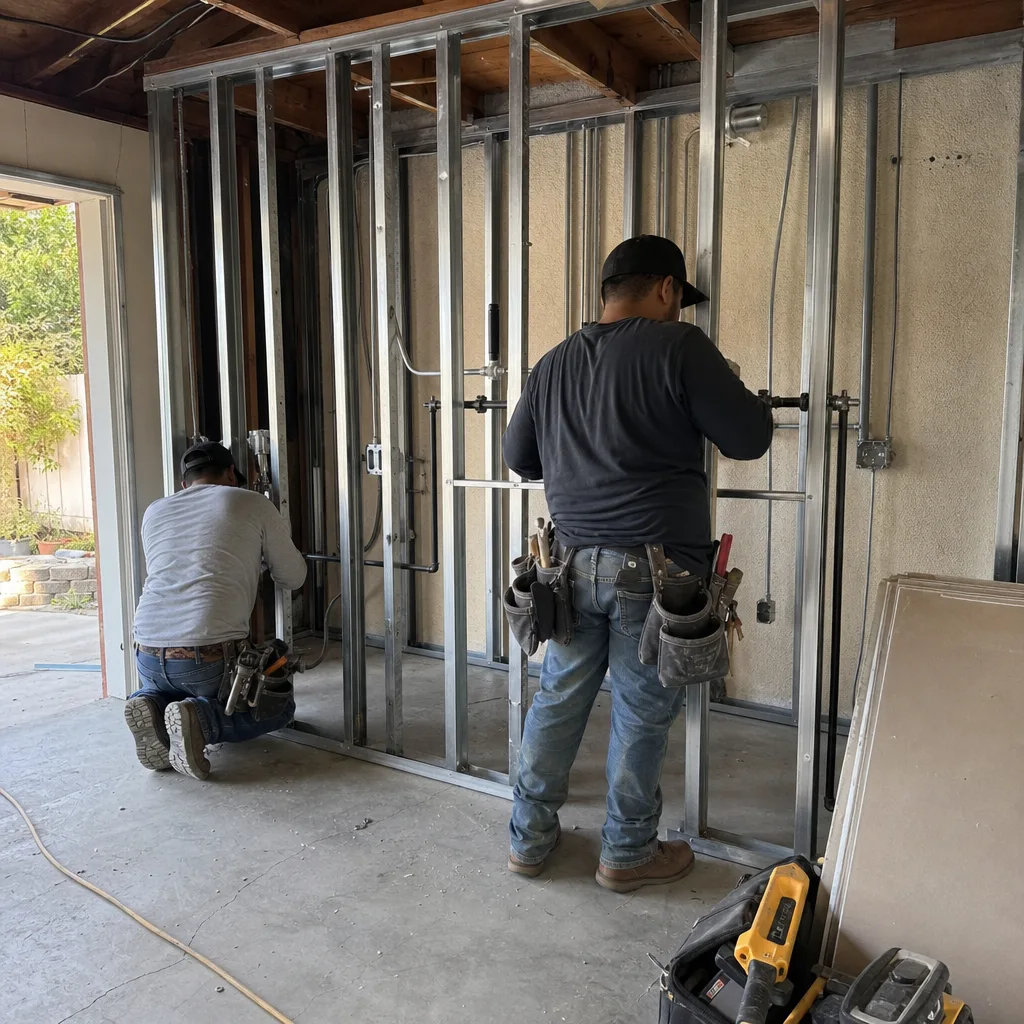
- Intermittent breaker trips on the subpanel. The Abodu unit draws a calculated load, but Upland’s older homes often have aluminum branch wiring or undersized mains that heat-cycle under sustained load. The breaker isn’t the problem; it’s the symptom of a mismatch between Abodu’s spec and your existing service that should have been caught in the load calculation phase of the permit set.
- Moisture staining at the wet wall baseboard. Abodu’s compact plumbing runs at higher pressure to serve the smaller footprint. When the PEX-to-cast iron transition wasn’t properly sleeved, or when Upland’s hard water scale has degraded the O-ring in the coupling kit, you get seepage that tracks along the sole plate. We’ve replaced three of these in the last 18 months, all on 1960s ranch homes north of Foothill Boulevard.
- HVAC can’t recover below 78°F on hot afternoons. The mini-split specified for Abodu’s junior line is right-sized for the volume, but the line-set penetration through your existing envelope is where the failure lives. In Upland’s climate, a degraded grommet or insufficient insulation on the suction line lets attic heat bleed in, and the compressor runs continuous without achieving setpoint.
- Floor deflection or squeaking at the module junction. Abodu’s floor system is engineered to precise tolerances, but the transition to your existing slab or raised foundation is where differential settlement shows up. In the Upland Hills area, we’ve seen this where expansive clay soil wasn’t properly addressed in the site prep specification.
- Permit red-tag at final inspection for missing documentation. This isn’t a physical part failure, but it’s the most expensive one. San Bernardino County inspectors are now cross-referencing Abodu serial numbers against approved permit sets; if your original contractor didn’t submit the manufacturer’s installation manual as an approved document, or if the electrical load calc doesn’t match the subpanel nameplate, you don’t get occupancy. We fix these retroactively, but it’s always more expensive than doing it in sequence.
Replacement Cost & What’s Included
For Upland Abodu junior ADU conversion work, our installed pricing breaks down as follows:
| Component / Service | Typical Range |
|---|---|
| Wet wall coupling kit replacement (parts + labor) | $1,800 - $3,400 |
| Electrical subpanel upgrade / load calc revision | $2,200 - $4,600 |
| Mini-split line-set penetration repair / reseal | $1,400 - $2,800 |
| Foundation tie-in anchor upgrade (seismic) | $2,600 - $5,200 |
| Full permit set revision + inspection coordination | $1,600 - $3,000 |
| Complete integration rebuild (all systems) | $12,000 - $22,000 |
The range depends on three factors: the age of your original installation (pre-2021 units need more adaptation), the accessibility of the failure point (a wet wall behind finished drywall adds demolition and repair), and whether we’re correcting someone else’s permit deficiency or building from a clean approved set. Every project is quoted with a written price before work begins, per Haven Standard Clause 1. The scope is locked at signing; no door-side upsells, no scope creep. Our 365-Day Done Right Promise covers the work: if the finished repair doesn’t match the permitted drawings, we make it right.
You’ll receive a documented photo record on every visit, a written warranty with part numbers specified, and a revised permit set if any changes were required. Read the clause, then read the cost range - if either one surprises you, we haven’t done our job yet.
DIY or Call Us?
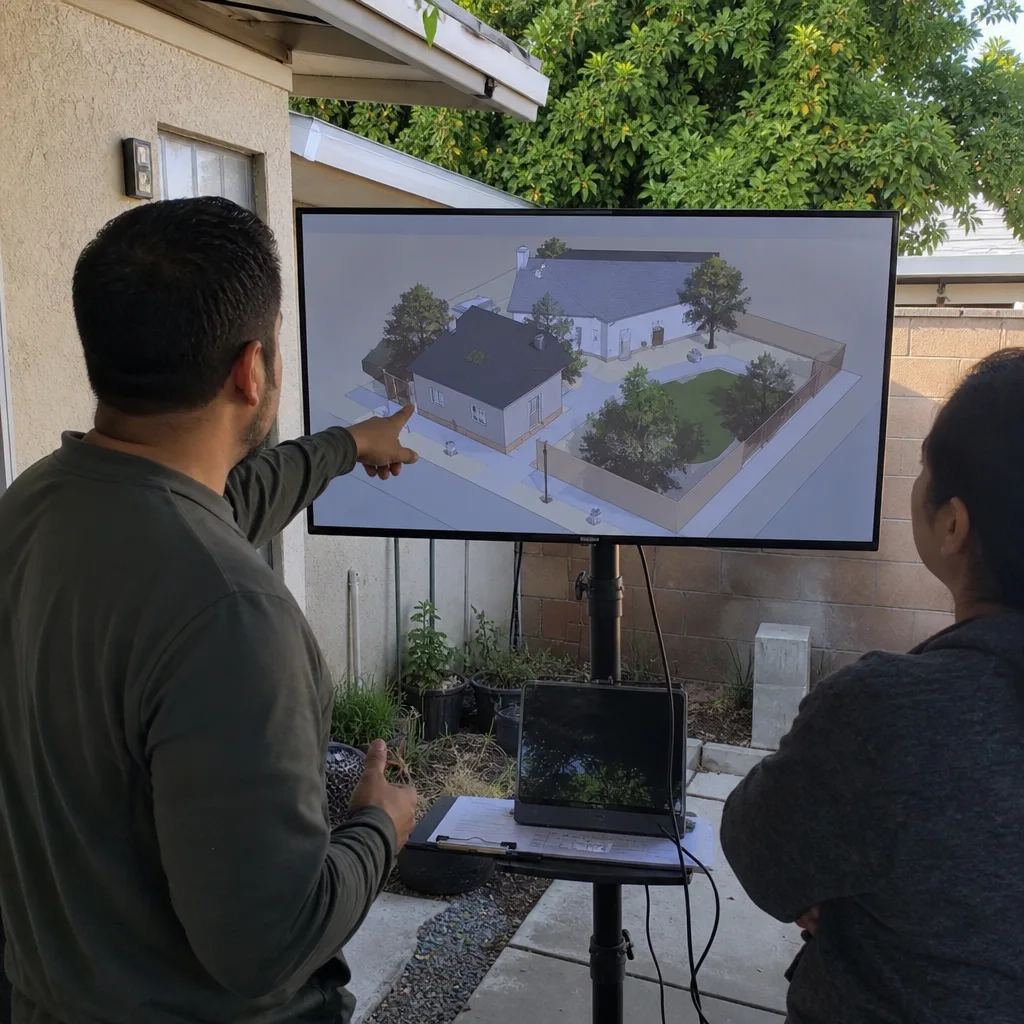
There’s a short list of what a competent Upland homeowner can safely check: verify the Abodu serial plate model year, confirm the breaker size against the subpanel nameplate, and visually inspect the wet wall access panel for obvious moisture. Do not attempt to disassemble the electrical subpanel, do not cut into the wet wall to access plumbing couplings, and do not recharge or modify the mini-split refrigerant lines. These are sealed systems with specific pressure requirements; improper handling voids the Abodu warranty and creates genuine safety hazards.
The integration points between a factory-built module and a 60-year-old Upland home are where design-build expertise matters. A licensed electrician needs to verify the load calc. A plumber needs to confirm the PEX-to-cast iron transition is sleeved correctly per San Bernardino County amendment. And the permit set needs to document all of it before the inspector arrives. If you’re seeing any of the five symptoms above, call (840) 212-3065. We’ll schedule your free estimate, review your existing documentation, and give you a written price before any work starts.
FAQs
The Abodu shell itself is rated for 50+ years, but the integration components - the wet wall couplings, line-set penetrations, and electrical adapters - typically need attention at 12-18 years in the Inland Empire. Upland’s combination of hard water, summer heat cycling above 100°F, and winter temperature swings below 40°F degrades seals and gaskets faster than coastal installations. Call (840) 212-3065 for an exact assessment of your system - estimates are free.
Sometimes. A compromised line-set grommet can be resealed if caught early, and certain electrical connections can be re-torqued if the aluminum wire hasn’t work-hardened. But wet wall coupling O-rings and failed subpanel breakers are replace-only; repair attempts on these components typically fail within months and cost more than doing it correctly the first time. We evaluate each system individually and document what we find with photos. Call (840) 212-3065 for a written repair-versus-replace recommendation.
Most component replacements - wet wall kit, electrical subpanel, line-set reseal - take 1-2 working days once materials are on site. We stock common Abodu-compatible hardware at our Upland facility, and we coordinate directly with certified suppliers for model-specific components that aren’t standard inventory. Full integration rebuilds run 5-8 working days, plus any required inspection scheduling with San Bernardino County. Your written quote includes a timeline with named milestones. Call (840) 212-3065 to schedule.
We stock the critical integration hardware - coupling kits, anchor brackets, line-set penetrations, and electrical adapters - for Abodu junior ADU conversions at our Upland facility. We do not stock Abodu OEM shell components; those ship factory-direct with a 6-10 week lead time. For most failure scenarios we encounter in Upland, the problem is at the integration point, not the shell, so our inventory covers the repair. If your situation requires factory-direct components, we coordinate that delivery within our single-contract scope. Call (840) 212-3065 and we’ll confirm what’s in stock for your specific model.
Ellery ADU Studio Upland is an independent design-build studio, not affiliated with Abodu. We specify and coordinate Abodu, Cover, Dvele, and other prefab systems within our single-contract model.
Written by Nadia Ellery, Principal, Ellery ADU Studio Upland at Ellery ADU Studio Upland, serving Upland and nearby areas.